2025-09-23
Mechanistic Dissymmetry between Crystal Growth and Dissolution drives Ratcheted Chiral Amplification
Publication
Publication
J. Am. Chem. Soc. , Volume 147 - Issue 42 p. 38508- 38515
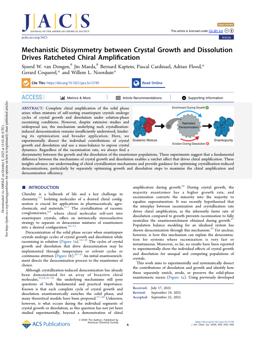
Complete chiral amplification of the solid phase arises when mixtures of self-sorting enantiopure crystals undergo cycles of crystal growth and dissolution under solution-phase racemizing conditions. However, despite extensive studies and widespread use, the mechanism underlying such crystallization-induced deracemization remains insufficiently understood, hindering its optimization and broader application. Here, we experimentally dissect the individual contributions of crystal growth and dissolution and use a mass-balance to expose crystal dynamics. Regardless of the racemization rate, we always find a dissymmetry between the growth and the dissolution of the enantiomer populations. These experiments suggest that a fundamental difference between the mechanisms of crystal growth and dissolution enables a ratchet effect that drives chiral amplification. These insights advance our understanding of chiral crystallization mechanisms and provide guidance for optimizing crystallization-induced deracemizations, particularly by separately optimizing growth and dissolution steps to maximize the chiral amplification and deracemization efficiency.
| Additional Metadata | |
|---|---|
| ACS | |
| Netherlands Organisation for Scientific Research (NWO) , Dutch Ministry of Education, Culture and Science , Horizon Europe | |
| doi.org/10.1021/jacs.5c12199 | |
| J. Am. Chem. Soc. | |
| Organisation | Self-Organizing Matter |
|
van Dongen, S., Maeda, J., Kaptein, B., Cardinael, P., Flood, A., Coquerel, G.& Noorduin, W. (2025). Mechanistic Dissymmetry between Crystal Growth and Dissolution drives Ratcheted Chiral Amplification. J. Am. Chem. Soc., 147(42), 38508–38515.https://doi.org/10.1021/jacs.5c12199 |
|