2026-01-29
Spontaneous switching in a protein signalling array reveals near-critical cooperativity
Publication
Publication
Nat. Phys. , Volume 22 p. 452- 460
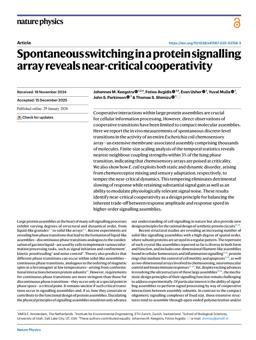
Cooperative interactions within large protein assemblies are crucial for cellular information processing. However, direct observations of cooperative transitions have been limited to compact molecular assemblies. Here we report the in vivo measurements of spontaneous discrete-level transitions in the activity of an entire Escherichia coli chemosensory array—an extensive membrane-associated assembly comprising thousands of molecules. Finite-size scaling analysis of the temporal statistics reveals nearest-neighbour coupling strengths within 3% of the Ising phase transition, indicating that chemosensory arrays are poised at criticality. We also show how E. coli exploits both static and dynamic disorder, arising from chemoreceptor mixing and sensory adaptation, respectively, to temper the near-critical dynamics. This tempering eliminates detrimental slowing of response while retaining substantial signal gain as well as an ability to modulate physiologically relevant signal noise. These results identify near-critical cooperativity as a design principle for balancing the inherent trade-off between response amplitude and response speed in higher-order signalling assemblies.
| Additional Metadata | |
|---|---|
| Springer Nature | |
| Netherlands Organisation for Scientific Research (NWO) | |
| doi.org/10.1038/s41567-025-03158-3 | |
| Nat. Phys. | |
| Organisation | Physics of Behavior |
|
Keegstra, J., Avgidis, F., Usher, E., Mulla, Y., Parkinson, J.& Shimizu, T. (2026). Spontaneous switching in a protein signalling array reveals near-critical cooperativity. Nat. Phys., 22, 452–460.https://doi.org/10.1038/s41567-025-03158-3 |
|