2026-05-01
Microfluidics-enabled proteomic profiling reveal iron-driven immune evasion by an antimicrobial-resistant pathogen
Publication
Publication
Cell Rep. Methods , Volume 6 - Issue 5 p. 101377: 1- 21
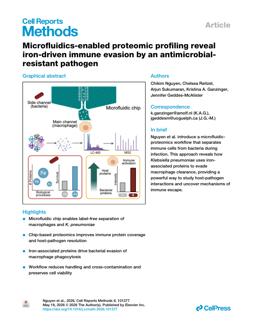
Dissecting host-pathogen interactions is challenging due to heterogeneous co-cultures and limited separation methods. Here, we developed a label-free microfluidic chip enabling reproducible separation of Klebsiella pneumoniae and murine macrophages during co-culture for high-resolution proteomic analysis. Using an optimized 1.4 mu m filter, the platform preserved cell viability while improving host protein identification and enriching immune-associated proteins compared to traditional scraping and supernatant collection. Chip-isolated non-phagocytosed bacteria displayed distinct proteome profiles, including reduced metabolic enzymes and increased biosynthetic and iron-binding proteins. Iron-associated proteins were uniquely enriched in this population, and functional assays confirmed that iron promotes macrophage evasion and bacterial survival. Together, these results establish a microfluidic-proteomic workflow for resolving complex host-pathogen dynamics and propose an iron-dependent mechanism of immune evasion. This approach reduces sample handling and cross-contamination while preserving cellular structure, providing a powerful framework for studying infection biology and identifying therapeutic targets.
| Additional Metadata | |
|---|---|
| Elsevier/ Cell Press | |
| doi.org/10.1016/j.crmeth.2026.101377 | |
| Cell Rep. Methods | |
| Organisation | Physics of Cellular Interactions |
|
Nguyen, C., Reitzel, C., Sukumaran, A., Ganzinger, K.& Geddes-McAlister, J. (2026). Microfluidics-enabled proteomic profiling reveal iron-driven immune evasion by an antimicrobial-resistant pathogen. Cell Rep. Methods, 6(5), 101377: 1–21.https://doi.org/10.1016/j.crmeth.2026.101377 |
|