2026-10-27
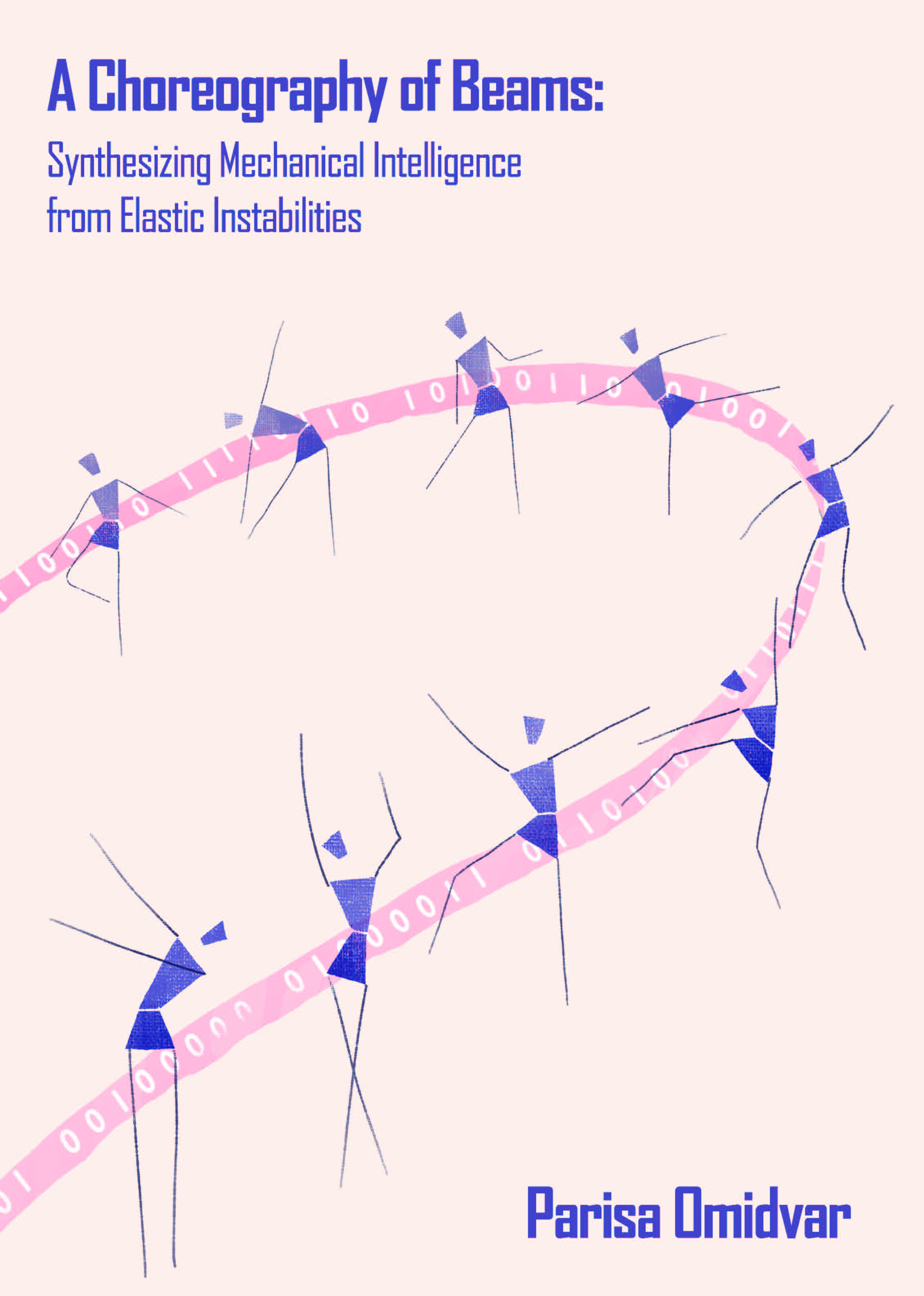
A Choreography of Beams: Synthesizing Mechanical Intelligence from Elastic Instabilities
Publication
Publication
Elastic deformation can be used as one of many forms that information can take. In particular, the two stable configurations of a buckled beam can encode and store binary information. Given that these individual information-bearing elements interact mechanically, the information can also be transported and processed from one beam to another. In this thesis, we first investigate how networks of these elements can be designed systematically. Designing such systems becomes increasingly difficult as the desired behavior becomes more complex, for example in a maze-navigating system. Inspired by design automation in digital electronics, we introduce a synthesis framework for automatically generating mass-spring networks from behavioral descriptions. We then investigate how information processing can be realized experimentally in elastic structures, starting with the transport of stored information. The stability that allows buckled beams to retain information also hinders changing and moving the information. We address this conflict by cyclically modulating the elastic elements. We temporarily destabilize selected states and experimentally realize directional, quantized transport of stored information through an elastic racetrack using a topological boundary-ratchet mechanism. To experimentally realize logic operations, we redesign the elastic elements and their interactions to make the system more robust. Using this platform, we experimentally demonstrate how mechanical information can be transported, inverted, copied into two paths, and combined through an OR operation in a synchronous, register-based architecture. Together, these results establish a route towards systematically embodying mechanical intelligence within the material itself.
| Additional Metadata | |
|---|---|
| M. van Hecke (Martin) , M. Serra-Garcia (Marc) | |
| Leiden University | |
| Organisation | Mechanical Metamaterials |
|
Omidvar, P. (2026). A Choreography of Beams: Synthesizing Mechanical Intelligence from Elastic Instabilities. |
|